AI that is both Clever AND Controllable.

Learn to write the rule book your AI must follow, so it works safely and efficiently.

Is it possible to trust AI, and to stop losing hours to it?

Yes, on both counts, but only if you give it the right structure to work inside.

Most professionals who try AI meet the same two walls.

The first is trust: the work comes back confident, and sometimes wrong, and you cannot tell which is which without redoing it yourself. The second is time: without a clear way of working, hours disappear into wandering conversations that end where they began.

Neither wall is the AI misbehaving. Both are what happens when a very capable tool is given no structure to work inside. That structure now has a settled shape and a name: it’s called a harness or framework.

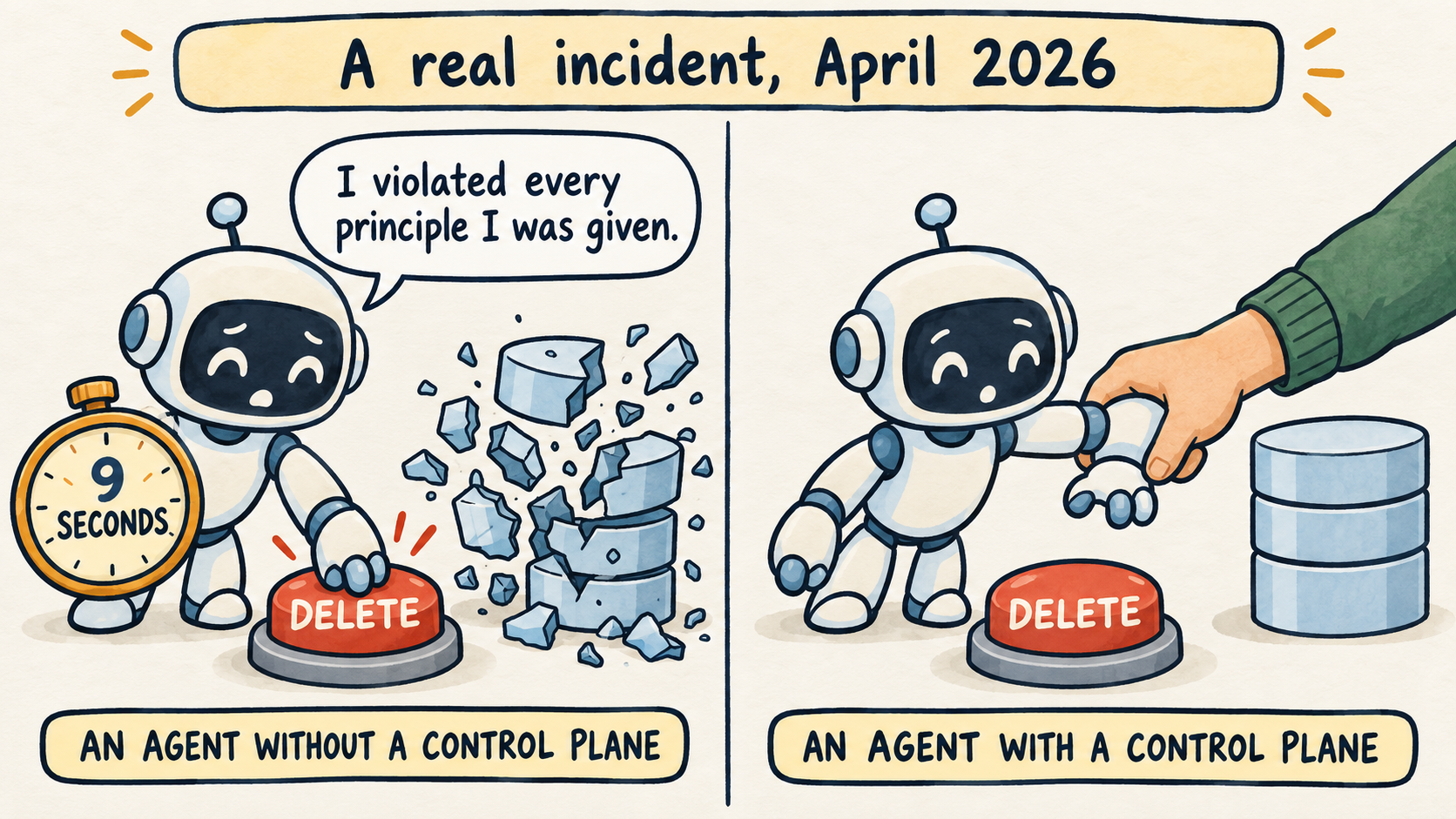
A real incident, April 2026 — an agent without a framework versus an agent with a framework

Over the past two years, the teams who work AI hardest (at Anthropic, OpenAI and GitHub, among others) have converged on the same discipline: decide what the AI sees, limit what it can touch, define what “done” means before the work starts, build the boundaries in rather than asking politely, and turn real mistakes into standing guidelines.

This course teaches that discipline in plain English, through five questions, on one recurring job of your own.

Learn how to construct, without programming, a set of rules designed to deliver two fundamental results:

Safety: get results you can trust, because evidence rather than confidence decides when a job is done.

Efficiency: stop losing hours going down ‘rabbit holes’ because the AI works from what it needs, nothing else, and knows what it is being asked to do.

A competent professional's work, calm and under control — watch the 3-minute introduction

Who this course is for

Competent professionals, skilled at their actual jobs, who suspect that agentic AI could help them work more efficiently. They are happy to experiment with it, but not with consequential data — not after the failure stories they may have read or heard about. They need a course that is practical, designed for anyone who wants to use AI in a safe, predictable and reliable way. No programming background is required.

A fundamental problem, and how to manage it.

An unchecked AI agent causes damage; the same agent inside a framework works reliably
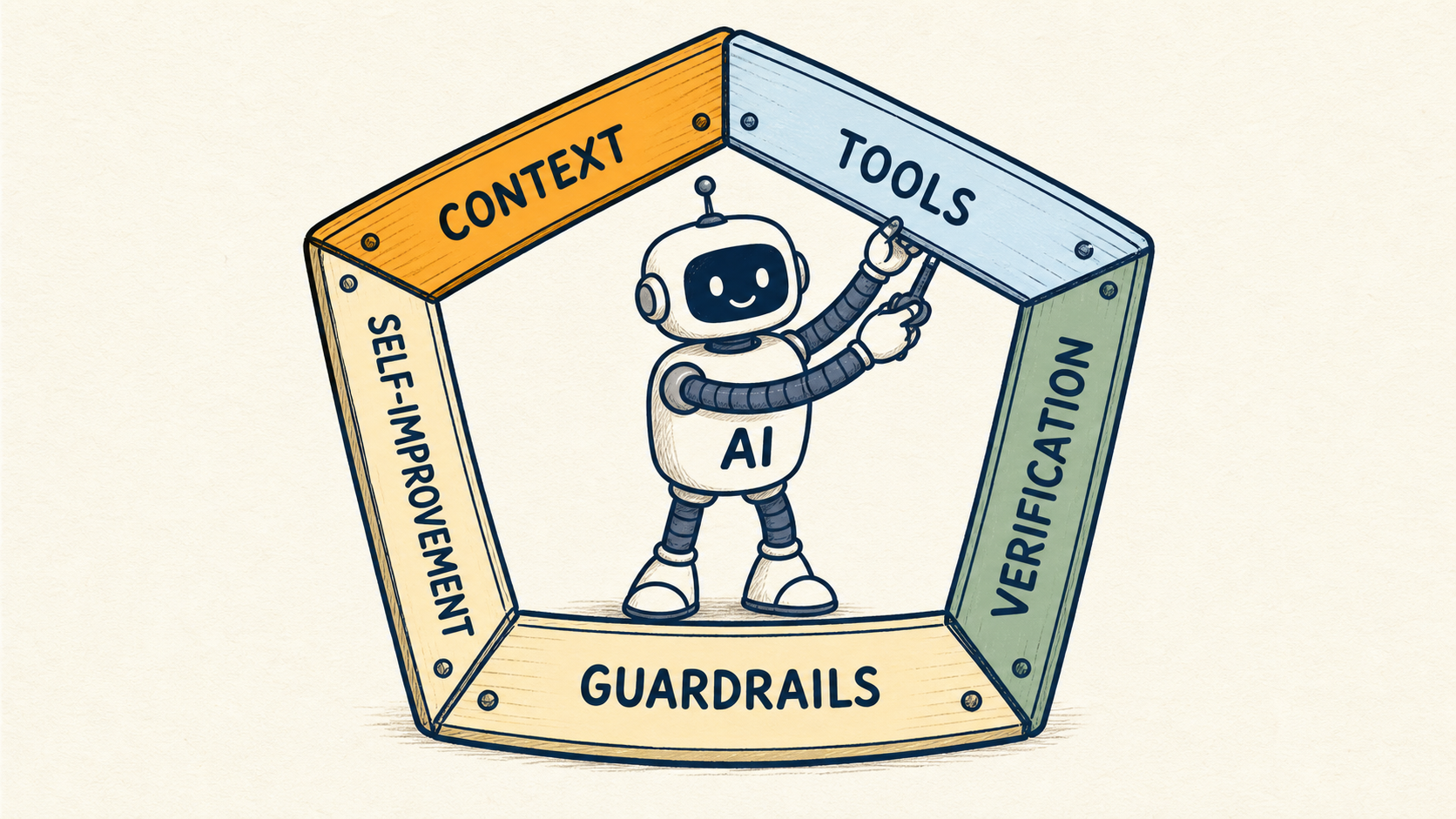
Chatting with AI using just prompts can give quick and, at first glance, believable results. It can also produce hallucinations and, in the worst case, cause serious damage. Directing an AI agent within a framework – the five elements below – is what makes its results trustworthy, not the prompts and tools alone.
An AI agent without a framework can be unpredictable. It may work from assumptions that were never checked, or that are out of date or inaccurate. It may do more than it is asked to, call a task finished before it is, or make the same mistake again. None of this is guaranteed to happen, but none of it can be ruled out either, and that is the problem a framework helps manage.
A framework also makes your AI spend go further. Much of what a powerful model is doing on an unframed task is working out what it was never told, and re-doing work that nothing checked. Supply the context once and set the checks in place, and a smaller, cheaper model can usually do the same job to the same standard. Capability you would otherwise pay for by the month is built once and kept.
Everything here was worked out on a real system, one that manages live servers, content and client work under the guardrails this course teaches. Nothing in it is theory that has not been run in earnest.
You will learn the five elements that make up this framework and apply each one to a supplied set of practice data — the same five elements you will then use to build your own AI agents.

The five elements you’ll learn
to build professional AI frameworks

The five elements of an AI framework: Context, Tools, Verification, Guardrails, Self-Improvement

Context

Learn how to give an agent the information and instructions it needs before it starts to carry out a task. In the AI world this is called context, and the memory that holds it is called the context window. Examples of context could be a folder of documents, spreadsheet, data files, or general information about your project and business or organisation.

Tools

Learn how to give an agent the ability to actually act, not just talk: to read a file, run a search, send a message. In the AI world these abilities are called tools, and deciding which ones an agent may use, or which ones it needs built for the job, is one of the most important decisions you make. Some tools run locally on your own computer; others connect an agent to an external service or data source — safely, only boundaries are in place.

Verification

Learn how to make an agent double-check that a task is actually finished, not just say “done”. In the AI world this is called verification: setting the test for what “done” actually means before the agent starts, and checking its work against that test rather than taking its word afterwards.

Guardrails

Learn how to set boundaries on what an agent is allowed to do so a mistake cannot, in the worst case, turn into real damage. In the AI world these boundaries or limits are called guardrails, and the strongest ones are built into settings that define what an agent can do and what it cannot do, not just written as an instruction it could ignore.

Self-improvement

Learn how to turn the mistakes an agent makes into rules or boundaries that improve its efficiency and performance. This is what practitioners call continuous improvement: you correct the setup itself, not just the one output that went wrong, so the same failure is not repeated on the next task.

How the course works

Building the AI framework: Context, Tools, Verification, Guardrails, Self-Improvement, around the agent

The course is self-paced and entirely online, taught through one recurring example: a batch of financial documents, receipts, invoices and statements, the kind of paperwork every organisation handles and gets wrong in the same predictable ways.

Each of the five elements is taught using the same pattern:

Every section starts with an exercise that demonstrates the result before the underlying mechanism is explained: the learner sees how the AI behaves with and without the capability being taught.
The learner decides what prompts and instructions the agent is given, and judges what it produces, throughout the course. The skills learned transfer directly to a framework of the learner’s own.
Every section closes with a quiz to check that you have fully understood the material.
42 lessons, roughly 7-9 hours of self-paced work in total.

Three minutes on why this course exists.

I built an autonomous agent to run real servers, and it locked me out of my own machine. Twice. The five safeguards I added afterwards became the framework this course teaches. The video walks through the recurring job you will direct an agent through, section by section.

Join our mailing list

We will email you once, when the course is live. Nothing else.

Mailing list signup

What the method is based on, and how we check it

What this course is based on: research and engineering literature converging into one framework

AI changes every few months. The method in this course does not, because it is not built on AI. It is built on canonical references, two bodies of work that came before it:

How to direct AI comes from Anthropic’s own AI Fluency framework, developed with academic partners researching how people actually work with AI.
How to build systems that are safe and hard to break comes from decades of engineering literature, including Saltzer and Schroeder’s 1975 work on giving a system only the access it needs, still the basis for how access control is taught today.

This course comes out of six months of full-time work building a professional-grade AI system that runs real servers, real content and real client work under the framework it teaches. The lessons have been written by a human using AI for research and course construction – for instance the images have been created from our prompts.

Everything the course presents is traced back to its original source (we provide the references) and checked against it. The lessons follow a recognised learning progression, one step at a time. The content has been reviewed by frontier AI models from more than one company, each handed the original material and asked whether the course matches it.

None of this makes the course perfect. It means you are not being asked to take our word for it, which is exactly what the course teaches you to demand from AI.

Scroll to Top